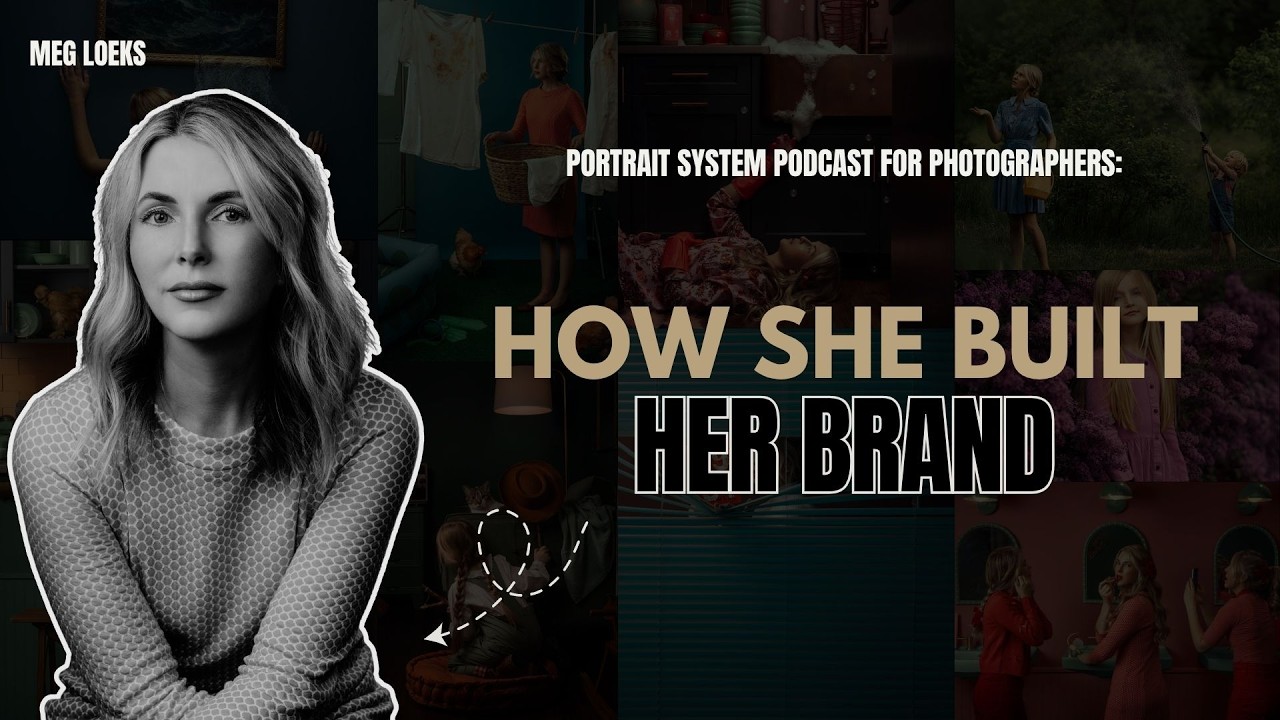
There is a specific kind of exhaustion that comes from running a photography business that was never really designed around your life. I know it because I lived it for two years before I started making deliberate structural decisions about what my studio actually looked like day to day. The photographers I respect most are the ones who figured out how to build something intentional, not just hustle their way into a calendar full of sessions they resent. That is exactly what drew me to this conversation between Nicki Klösser and Meg Loeks on The Portrait System podcast. Watch the full tutorial on YouTube
Meg is a Michigan-based fine art family photographer who started from a genuinely relatable place: picking up her camera again after having kids, sharing her work on social media, and watching interest organically grow into a business. She also brought something most photographers don’t think to use: an advertising degree and corporate marketing experience. That combination shaped how she positioned and grew her work, and the lessons translate whether you shoot fine art or straightforward lifestyle family sessions.
What I want to do here is pull out the actual strategic moves from this conversation, the ones you can apply this week, not someday. These are not vague inspirational takeaways. They are decisions with consequences, and Meg made them clearly.
Step 1: Treat Your Personal Work as a Portfolio and a Marketing Tool
 Meg describing sharing children’s photos on social media
Before Meg had a business, she had a camera and kids. She started photographing her children and posting that work on social media, not as a marketing campaign, but because she genuinely wanted to document her family. The important move here was that the work was specific and consistent in style. It reflected who she was creatively, which meant the people who responded to it were already pre-qualified as future clients.
Meg describing sharing children’s photos on social media
Before Meg had a business, she had a camera and kids. She started photographing her children and posting that work on social media, not as a marketing campaign, but because she genuinely wanted to document her family. The important move here was that the work was specific and consistent in style. It reflected who she was creatively, which meant the people who responded to it were already pre-qualified as future clients.
If you are in early stages, this is your actual starting point. Do not shoot generic content hoping to appeal to everyone. Shoot the thing you care about, share it consistently, and let the people who connect with that work come to you. Your personal projects are not separate from your business development. They are the foundation of it.
Step 2: Use Your Previous Career Skills Strategically
 Meg discussing her corporate marketing background
Meg did not abandon her advertising and corporate marketing experience when she picked up her camera. She brought it with her. That background gave her a framework for thinking about audience, positioning, and how to present work in a way that communicates value. Most photographers treat their pre-photography career as irrelevant. That is a mistake.
Meg discussing her corporate marketing background
Meg did not abandon her advertising and corporate marketing experience when she picked up her camera. She brought it with her. That background gave her a framework for thinking about audience, positioning, and how to present work in a way that communicates value. Most photographers treat their pre-photography career as irrelevant. That is a mistake.
Sit down and write out every transferable skill from your previous work life: project management, client communication, writing, design, sales, budgeting. These are competitive advantages. A photographer with a client experience process built from actual business operations knowledge will outperform one who is winging it, every single time. I track 47 line items in my client experience checklist because I came up through a background that valued process. That is not perfectionism. That is professionalism.
Step 3: Make the Leap with Evidence, Not Just Courage
 Meg transitioning from corporate job to photography business
Meg had a real corporate job at a health IT company when her photography interest was building. The transition away from that job was not an impulsive leap. It grew from demonstrated demand. People were actively asking her to photograph their families before she had a formal business. That inbound interest is your signal.
Meg transitioning from corporate job to photography business
Meg had a real corporate job at a health IT company when her photography interest was building. The transition away from that job was not an impulsive leap. It grew from demonstrated demand. People were actively asking her to photograph their families before she had a formal business. That inbound interest is your signal.
Do not quit the day job the moment you feel passionate about photography. Wait until you have proof of market. That proof looks like: people reaching out unprompted, repeat referrals, clients willing to pay real prices without negotiating. Track that data. When the evidence is there, act on it.
Step 4: Define Your Visual Identity Before You Scale
 Host describing Meg’s use of color and styling in portraits
One of the throughlines of Meg’s work is a deeply intentional visual style: deliberate use of color, careful styling, and thoughtful detail that makes her portraits feel like illustrations. This is not accidental, and it is not just aesthetic preference. It is a business decision. When your work has a recognizable signature, you become the obvious choice for a specific kind of client rather than one option among dozens.
Host describing Meg’s use of color and styling in portraits
One of the throughlines of Meg’s work is a deeply intentional visual style: deliberate use of color, careful styling, and thoughtful detail that makes her portraits feel like illustrations. This is not accidental, and it is not just aesthetic preference. It is a business decision. When your work has a recognizable signature, you become the obvious choice for a specific kind of client rather than one option among dozens.
Before you run ads or push for volume, get clear on what makes your images unmistakably yours. Study your own portfolio. What are the consistent elements? What do you do in editing that no one else does? Build your marketing around that specificity. Trying to appeal to everyone is the fastest way to be memorable to no one.
Step 5: Let Education Become a Second Revenue Stream Naturally
 Nicki explaining Meg’s shift from shooting to full-time education
Meg’s move into photography education did not happen as a pivot away from failure. It happened because she had built enough expertise and reputation in her shooting career that other photographers genuinely wanted to learn from her. She started with a little education alongside her client work, and over time that grew into its own lane.
Nicki explaining Meg’s shift from shooting to full-time education
Meg’s move into photography education did not happen as a pivot away from failure. It happened because she had built enough expertise and reputation in her shooting career that other photographers genuinely wanted to learn from her. She started with a little education alongside her client work, and over time that grew into its own lane.
The lesson here is sequencing. You cannot sell education on how to build a thriving photography business if you have not actually built one. The credibility has to come first. If you are interested in eventually teaching, the work you do now in your client business is not separate from that goal. It is the prerequisite. Document your process, your systems, your pricing decisions. That material is future curriculum.
Step 6: Let Life Circumstances Inform Your Business Model
 Meg discussing family circumstances influencing the shift to education
At a certain point, changes in Meg’s personal life made a full-time shooting schedule less workable. Instead of forcing the original model to continue, she restructured toward education, which offered more flexibility while still leveraging everything she had built. This is not giving up. This is intelligent design.
Meg discussing family circumstances influencing the shift to education
At a certain point, changes in Meg’s personal life made a full-time shooting schedule less workable. Instead of forcing the original model to continue, she restructured toward education, which offered more flexibility while still leveraging everything she had built. This is not giving up. This is intelligent design.
Your business model should be revisited every year, not just when something goes wrong. Ask yourself whether the structure still fits your life as it actually is, not as it was two years ago. The photographers I see burning out are the ones who built a machine in year one and refused to adjust it even as their life changed around it.
The Part They Didn’t Say Out Loud But You Should Hear
I want to add one thing that runs beneath this entire conversation. Meg’s advertising background gave her something most photographers lack: she understood that photography is a product and that products need positioning. The fine art framing of her work is not pretentious labeling. It is a positioning decision that selects for clients who value art over commodity images, which directly supports higher pricing.
When I finally stopped being afraid to present my work as art worth investing in rather than a service priced for accessibility, my average sale changed. My accountant husband had been quietly pointing at my numbers for a year before I listened. The work did not change. The framing did.
The single most important thing I took from this tutorial is that a sustainable photography business is built in layers: personal work first, then demonstrated demand, then a distinct visual identity, then systems, then education if that fits. Skip the layers and you build on sand.
Watch the full tutorial on YouTube and pay close attention to how Meg talks about the relationship between her life circumstances and her business structure. That part of the conversation is short but it is the most useful thing in it.
Comments (9)
Finally someone explains this in a way that actually makes sense.
Quality content like this is rare. Keep it up.
Couldn't agree more. I've seen this make a huge difference in color grading work specifically.
Shared this with my photography group. Everyone loved it.
Quality content like this is rare. Keep it up.
Bookmarked. Coming back to this one for sure.
This is going in my reference folder. Incredibly useful.
I tried this on a client project yesterday and the results were way better than expected.
This saved me so much time on my last edit. Wish I'd found this sooner.
Leave a Comment