When a Single Session Isn’t Enough Anymore
I track everything in my studio. Session counts, average sale, client return rate, referral source. All of it. And a pattern I kept seeing in my own numbers was this: clients who came in for one portrait and never came back weren’t the problem. The problem was that I wasn’t giving them a reason to stay connected to what we made together.
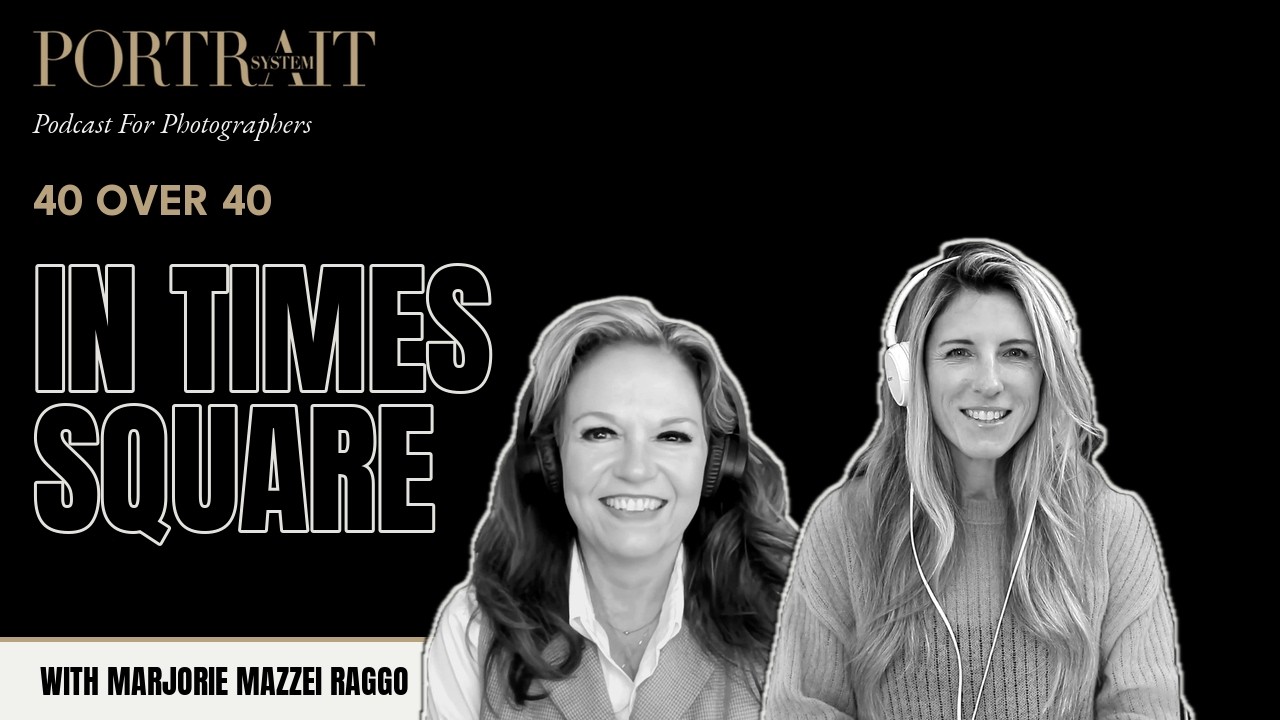
A themed campaign campaign changes that equation entirely. It creates something bigger than a single session, something clients feel part of rather than just customers of. That’s what hit me when I watched Marjorie Mazzei Raggo’s conversation with Nikki Closser on The Portrait System. Watch the full tutorial on YouTube before you read further, because the visual storytelling in that conversation adds a layer I can’t fully replicate in text.
The Architecture of a Campaign That Grows Itself
Marjorie didn’t launch the 40 Over 40 Revolution with a Times Square budget. She launched it with a concept and a small circle of friends and former clients. That starting point matters, because it’s accessible. You don’t need a marketing agency. You need a clear idea and people who already trust you.
The campaign celebrated women over 40, specifically their individuality and their stories. Each participant got a personalized magazine cover featuring her portrait, her name, and a headline that reflected something true about who she is. Not a generic template slapped with a new face. A designed cover built around each woman’s look, personality, and narrative. That level of customization is what turned participants into ambassadors. When someone sees herself on something that feels like it was made for her, she shares it. That’s your marketing, and it costs you creative time, not ad spend.
She built the experience around three pillars that any portrait photographer can replicate: a thorough consultation before the session, wardrobe direction tailored to each client, and a final product that told her individual story. The consultation is where most photographers rush or skip entirely. Marjorie used it as the foundation. By the time a client arrived for her session, she already felt seen. The camera just confirmed it.
What the Numbers Actually Looked Like
Marjorie and Nikki got specific about the business side, which I appreciated. The campaign ran over four years. That timeline is not a flaw. It’s a feature. A multi-year campaign builds momentum, media interest, and community in a way that a one-off event simply cannot. Each year the story got bigger, which is exactly what landed her clients’ portraits on a Times Square billboard.
Session fees and print sales covered the operational costs of the campaign. The Times Square moment, which sounds expensive on the surface, came through a service that makes billboard placements accessible at a fraction of what most people assume it costs. Marjorie was transparent about this, and Nikki pushed her to be, which is the kind of real-numbers conversation our industry desperately needs. Photographers often see a headline like “Times Square billboard” and assume it’s out of reach. Sometimes it isn’t. You just have to ask the question.
The print sales came from clients who were emotionally invested in the outcome. That’s the lever. When someone is part of a campaign that celebrates her, she doesn’t just buy an eight-by-ten because she needs wall art. She buys because the image means something. That’s the difference between selling photography and selling an experience that happens to result in photography.
The Lasting Weight of a Portrait After Loss
One thread in this conversation stopped me completely. Marjorie talked about the lasting value of portraits after someone is gone, the idea that an image made with intention becomes something a family holds onto in a way a phone snapshot never will.
I know this personally. I’ve had clients come back to me years after a session, not to book again, but to tell me that the portrait I made of their mother is now the image on her memorial card. That kind of impact doesn’t show up in my metrics. But it’s the reason the work matters, and it’s the argument I make, quietly, every time a client hesitates over the investment.
Marjorie built her entire campaign around making women feel seen before that moment of loss arrives. That’s the pitch, even if you never say it out loud. The portrait is proof that she was here, that she mattered, that someone took the time to see her clearly.
Where I’d Extend This for My Own Studio
I’d adapt the magazine cover concept by making it seasonal or annual rather than campaign-based. A “Client of the Year” feature, designed individually for a small group of women each December, would accomplish the same emotional goal without requiring a four-year arc. It’s a lower barrier to start, and it creates a recurring reason to reconnect with past clients.
The piece of Marjorie’s approach I’d push back on slightly is the reliance on friends and former clients as the primary recruitment pool. That’s a smart starting point, but it can cap your growth at the edges of your existing network. Pairing the campaign with one local media pitch, even a neighborhood blog or a community Facebook group, early in year one would accelerate the momentum without complicating the intimate feel she built so carefully.
The One Thing Worth Taking Into Your Next Client Conversation
A campaign built around a specific person, her story, her look, her moment, is fundamentally different from a session built around your portfolio. Marjorie’s work grew because every woman who participated felt like the subject, not the product.
Build the experience first. The sales follow from that.
Watch the full tutorial on YouTube to hear Marjorie walk through the campaign details, the costs, and the advice she gives photographers who are still afraid to charge what their work is worth.
Comments (10)
Printing this out and pinning it next to my monitor. That good.
The before and after really sells it. Incredible difference.
Wow, I had no idea you could do this. Mind blown.
Never thought of approaching it this way. Really creative.
Great article! I actually covered something related on my site — the photography angle is really complementary to this.
Love how you break down complex stuff into manageable steps.
Really solid breakdown. This pairs perfectly with the retouching work I've been writing about.
Printing this out and pinning it next to my monitor. That good.
Applied this to my portfolio shots and the improvement is noticeable.
Love this. I referenced a similar technique in one of my recent posts. Always good to see other perspectives.
Leave a Comment