Every January, I used to open my booking calendar and feel my stomach drop. December holiday sessions had wrapped up, the inquiry emails had dried to a trickle, and I’d sit there refreshing my inbox like that was going to fix anything. I knew the slow season was coming. I’d lived through it before. And I still let it catch me off guard every single year.
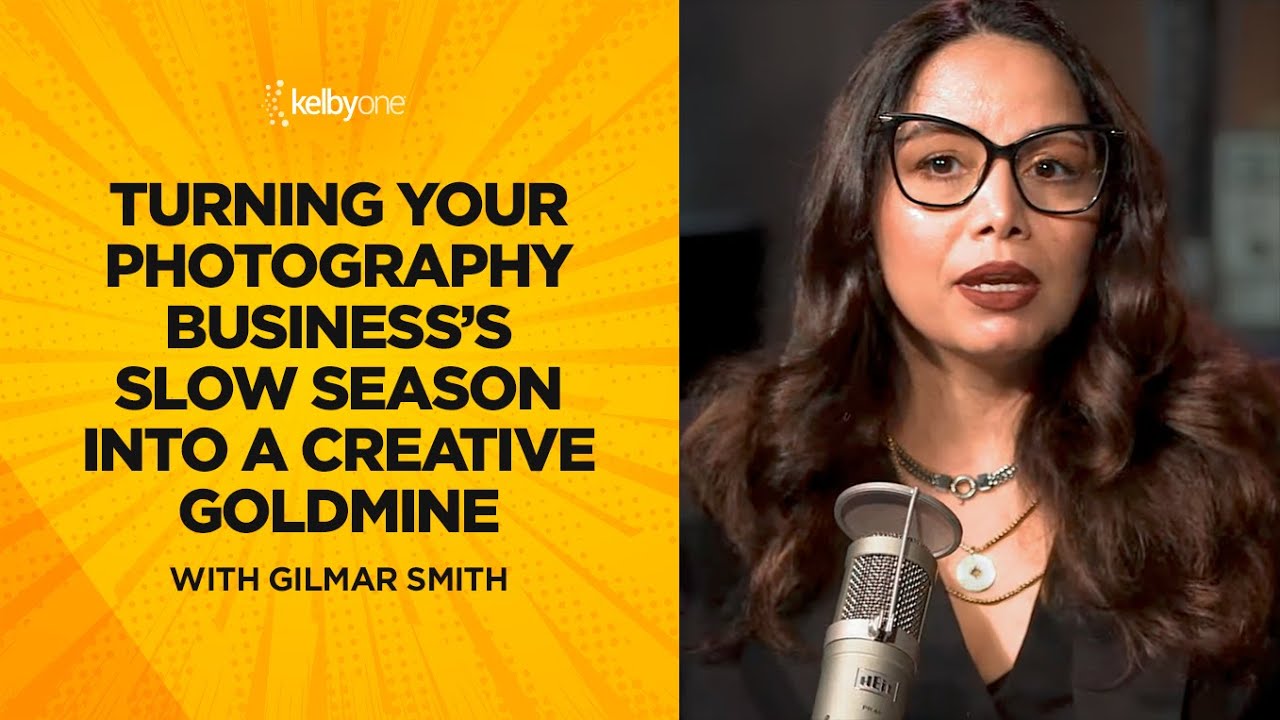
That changed when I started treating the quiet months as a planning and product-development window rather than a waiting room. Which is exactly what photographer Gilmar Smith breaks down in this KelbyOne tutorial. Watch the full tutorial on YouTube – it’s a candid, practical conversation about what she actually does when bookings slow down, and it reframed how I think about the calendar entirely.
Smith photographs families and personal brands out of a colorful, high-energy style that is distinctly her own. She’s not teaching theory. She’s walking through the exact thinking that led her to build a new revenue stream during the two months that used to stress her out the most. If you shoot portraits, families, or anything that follows a seasonal rhythm, this is worth your full attention.
Step 1: Name Your Slow Months Honestly
 Gilmar identifying summer and December as her two slow periods
Before you can fix the slow season, you have to stop pretending it doesn’t exist. Smith opens by naming her two dead zones without apology: summer, when school is out and family session demand drops, and the post-holiday window in late December through January. She used to panic through both. The first move is to look at your own booking data and identify your specific slow windows with actual dates, not a vague sense that “things get quiet.”
Gilmar identifying summer and December as her two slow periods
Before you can fix the slow season, you have to stop pretending it doesn’t exist. Smith opens by naming her two dead zones without apology: summer, when school is out and family session demand drops, and the post-holiday window in late December through January. She used to panic through both. The first move is to look at your own booking data and identify your specific slow windows with actual dates, not a vague sense that “things get quiet.”
Pull your invoices from the last two years. Find the six to eight weeks where your revenue was lowest. Write them on your calendar right now, before the busy season convinces you it won’t happen again. Those weeks are your new product-development sprint.
Step 2: Audit What’s Actually Working in Your Current Marketing
 Gilmar describing the moment she asked what she could do in January
Smith’s turning point came when she stopped asking “how do I survive January?” and started asking “what do I already do that people respond to?” She had been posting self-portraits in her signature bright, playful style – not as a business strategy, just as creative expression. Those posts consistently generated client inquiries. People wanted that energy for themselves.
Gilmar describing the moment she asked what she could do in January
Smith’s turning point came when she stopped asking “how do I survive January?” and started asking “what do I already do that people respond to?” She had been posting self-portraits in her signature bright, playful style – not as a business strategy, just as creative expression. Those posts consistently generated client inquiries. People wanted that energy for themselves.
This is a metrics question, not a feelings question. Go into your Instagram or Facebook insights and sort your posts by saves and profile visits, not just likes. What content made someone stop and reach out? That pattern is your slow-season product waiting to be packaged.
Step 3: Design a New Offer That Fits Your Existing Style
 Gilmar explaining the origin of her personal brand session idea
Smith did not invent a new photographic style to fill the slow season. She took what she was already doing in her self-portraits – colorful, personality-driven, high-energy – and formalized it as a branded product: personal brand sessions. The key distinction here is that she refused to copy what everyone else was offering, which was the neutral-toned, laptop-on-a-desk aesthetic that dominates the branding photography market.
Gilmar explaining the origin of her personal brand session idea
Smith did not invent a new photographic style to fill the slow season. She took what she was already doing in her self-portraits – colorful, personality-driven, high-energy – and formalized it as a branded product: personal brand sessions. The key distinction here is that she refused to copy what everyone else was offering, which was the neutral-toned, laptop-on-a-desk aesthetic that dominates the branding photography market.
Your offer should be a natural extension of the work your best clients already hire you for. If you shoot moody, editorial family sessions, your slow-season offer might be editorial personal branding for authors or small business owners who want that same cinematic look. Match the offer to your visual identity. Trying to build a service in a style you don’t love is a setup for burnout and inconsistent results.
Step 4: Position the Offer Around the Client’s January Mindset
 Gilmar noting that people enter the new year ready to invest in themselves
Timing matters more than most photographers realize. Smith specifically targets January for personal brand sessions because her clients are already in a “new year, new chapter” headspace. They are actively thinking about leveling up their business presence. You are not convincing them they need something – you are showing up at the exact moment the need already exists.
Gilmar noting that people enter the new year ready to invest in themselves
Timing matters more than most photographers realize. Smith specifically targets January for personal brand sessions because her clients are already in a “new year, new chapter” headspace. They are actively thinking about leveling up their business presence. You are not convincing them they need something – you are showing up at the exact moment the need already exists.
Build your marketing language around what your client is already telling themselves in those weeks. If they’re posting about fresh starts and business goals, your session pitch should speak directly to visibility, credibility, and showing up as the face of their brand. The offer isn’t “get photos taken.” The offer is “look like the business you’re becoming.”
Step 5: Price the Offer to Reflect the Depth of Work Involved
 Gilmar explaining that her personal brand sessions are priced higher than standard headshots
Smith is direct about this: personal brand sessions are priced above her standard sessions because they require more. More pre-session research, more strategic conversation with the client, more direction during the shoot to pull out personality rather than just a pleasant expression. The price reflects the process, not just the deliverable.
Gilmar explaining that her personal brand sessions are priced higher than standard headshots
Smith is direct about this: personal brand sessions are priced above her standard sessions because they require more. More pre-session research, more strategic conversation with the client, more direction during the shoot to pull out personality rather than just a pleasant expression. The price reflects the process, not just the deliverable.
If you are doing discovery calls, reviewing client questionnaires, and customizing the shoot environment and wardrobe direction for each person, that labor has a dollar value. A standard headshot session runs on a repeatable process. A personal brand session is consultative work. Price it accordingly. Smith’s clients who invest at a higher rate also show up more prepared, more committed, and more likely to refer.
Step 6: Treat Each Client’s Personality as the Creative Brief
 Gilmar discussing realtors as a primary market, each with distinct personalities
The fastest way to commoditize your brand photography is to shoot every client in the same three poses with the same two backgrounds. Smith’s approach is the opposite: she uses each client’s personality, values, and business story as the creative direction for the session. She mentions realtors specifically as a market where this pays off – they are individually distinct even within the same industry, and that difference is exactly what makes their personal brand valuable.
Gilmar discussing realtors as a primary market, each with distinct personalities
The fastest way to commoditize your brand photography is to shoot every client in the same three poses with the same two backgrounds. Smith’s approach is the opposite: she uses each client’s personality, values, and business story as the creative direction for the session. She mentions realtors specifically as a market where this pays off – they are individually distinct even within the same industry, and that difference is exactly what makes their personal brand valuable.
Before the session, get specific. Ask your client what three words they want their audience to use to describe them. Ask what they want clients to feel when they land on their website. That language becomes your shot list. You’re not just taking photos – you’re solving a positioning problem with your camera.
What I’d Add From My Own Studio
Smith’s framework is solid and I use a version of it in my own business. The piece I’d layer on top is a simple pre-consultation intake form that captures the client’s brand colors, competitor references, and one piece of content they wish they had photos for. That last question is a goldmine. Clients will tell you exactly what they need if you ask the right question, and it makes the session feel custom from the first touchpoint.
I track conversion rates from inquiry to booked session for every offer type in my studio, and personal brand sessions consistently close at a higher rate in January and February than any other time of year. The mindset Smith describes – people entering the new year ready to invest – shows up clearly in the numbers. The offer works because the timing works.
The single most important idea in this tutorial is that the slow season is a scheduling problem, not a business failure. You already have a style, a market, and a set of skills. The slow months are simply the window to package what you already do into something your ideal client needs right now.
Watch the full tutorial on YouTube and pay attention to how Smith talks about staying true to her visual identity even while building something new. That discipline is what makes the offer sustainable.
Comments (2)
My workflow just got 10x faster. Not even kidding.
This is exactly what I needed today. Been struggling with this for weeks.
Leave a Comment