I ran my portrait studio for almost two years before I admitted I had a client flow problem. Not a talent problem. Not a pricing problem. A pipeline problem. I was posting consistently on Instagram, crossing my fingers, and wondering why some months were feast and others were pure famine. The uncomfortable truth was that I had never built a real system for finding clients. I was just hoping they would show up, and hope is not a strategy.
That changed when I worked through this Hugo Korhonen tutorial on getting photography clients in 2026. Watch the full tutorial on YouTube. Hugo photographs full-time and has worked with brands like Sony and Adobe, and in this video he walks through what he calls his Client Flow System, specifically the two foundational steps: finding clients and then converting them. What hit me hardest was how clearly he names the mistake most photographers make, including me. We sit around waiting to “earn” clients through visibility, when in the early stages, that is simply not how businesses work.
The framework he uses comes from Alex Hormozi’s Core 4, and Hugo applies it specifically to photography in a way that finally made the whole client acquisition picture click for me. Here is the full breakdown so you can start using it without having to piece it together yourself.
Step 1: Understand That Outreach Is Your Job Right Now
 Hugo explaining why photographers wait instead of hunt
Before you touch any tactic, Hugo draws a hard line that I wish someone had drawn for me earlier. In the beginning of your business, you do not get to wait for clients. You have not yet built the reputation, the referral network, or the content library that earns you inbound leads. That comes later. Right now, your job is to go find people, contact them, and get them interested. Accepting this shift in mindset from passive to active is the actual Step 1, because if you skip it, none of the tactics below will stick.
Hugo explaining why photographers wait instead of hunt
Before you touch any tactic, Hugo draws a hard line that I wish someone had drawn for me earlier. In the beginning of your business, you do not get to wait for clients. You have not yet built the reputation, the referral network, or the content library that earns you inbound leads. That comes later. Right now, your job is to go find people, contact them, and get them interested. Accepting this shift in mindset from passive to active is the actual Step 1, because if you skip it, none of the tactics below will stick.
Step 2: Map the Four Channels You Can Use
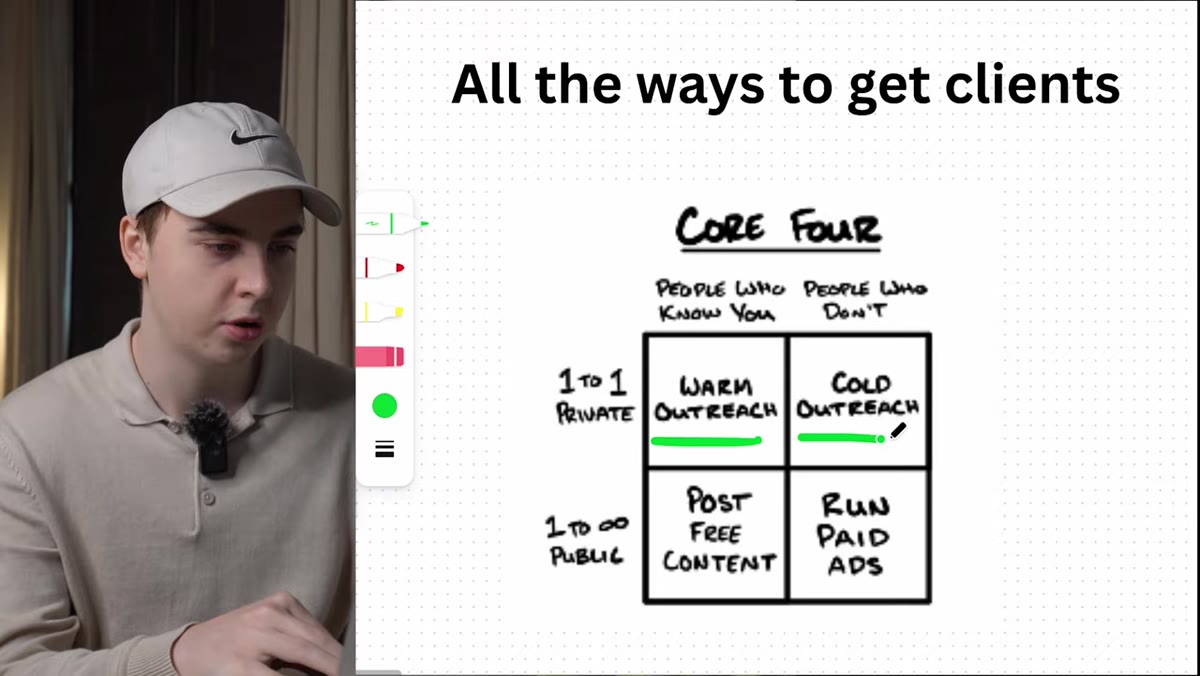 Hugo listing all four Core 4 methods on screen
Hugo lays out four and only four ways any business can acquire clients. Warm outreach, cold outreach, free content, and paid ads. That is the complete universe. Every photographer you see “crushing it” on social media or landing big brand deals is using some combination of these four, whether they know it or not. Writing them down this cleanly is useful because it stops you from chasing a fifth imaginary option. There is no secret platform or magic referral fairy. You pick from these four, you execute, and you build from there.
Hugo listing all four Core 4 methods on screen
Hugo lays out four and only four ways any business can acquire clients. Warm outreach, cold outreach, free content, and paid ads. That is the complete universe. Every photographer you see “crushing it” on social media or landing big brand deals is using some combination of these four, whether they know it or not. Writing them down this cleanly is useful because it stops you from chasing a fifth imaginary option. There is no secret platform or magic referral fairy. You pick from these four, you execute, and you build from there.
Step 3: Start With Warm Outreach First
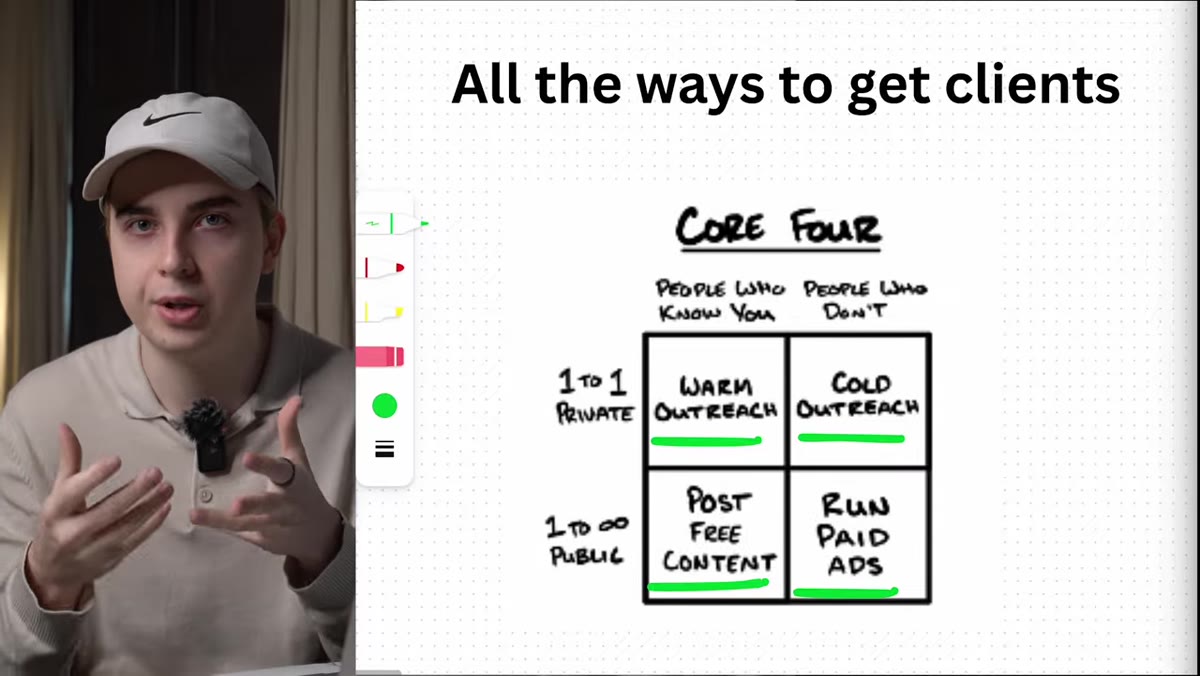 Hugo emphasizing starting with warm network before cold
Warm outreach means reaching out one-on-one to people who already have some awareness of you. Former clients, friends, family, past colleagues, people you went to school with, anyone who would recognize your name when they see it in their inbox. Hugo is emphatic here: this is where you start, not cold outreach, not paid ads. The reason is conversion math. Someone who already knows you is dramatically more likely to respond, book, or refer you than a stranger receiving a cold pitch. Your warm network is an underused asset, and tapping it first means you get early momentum and real feedback without spending a dollar.
Hugo emphasizing starting with warm network before cold
Warm outreach means reaching out one-on-one to people who already have some awareness of you. Former clients, friends, family, past colleagues, people you went to school with, anyone who would recognize your name when they see it in their inbox. Hugo is emphatic here: this is where you start, not cold outreach, not paid ads. The reason is conversion math. Someone who already knows you is dramatically more likely to respond, book, or refer you than a stranger receiving a cold pitch. Your warm network is an underused asset, and tapping it first means you get early momentum and real feedback without spending a dollar.
Practically, this means making a list. Open a notes app, a spreadsheet, whatever you actually use, and write down every person in your life who might need photography or know someone who does. Then draft a short, personal message that explains what you are offering right now. Not a mass email blast. One-on-one, individual messages that feel like they came from a human being, because they should.
Step 4: Move to Cold Outreach Once Warm Is Maximized
 Hugo defining cold outreach as one-on-one private contact
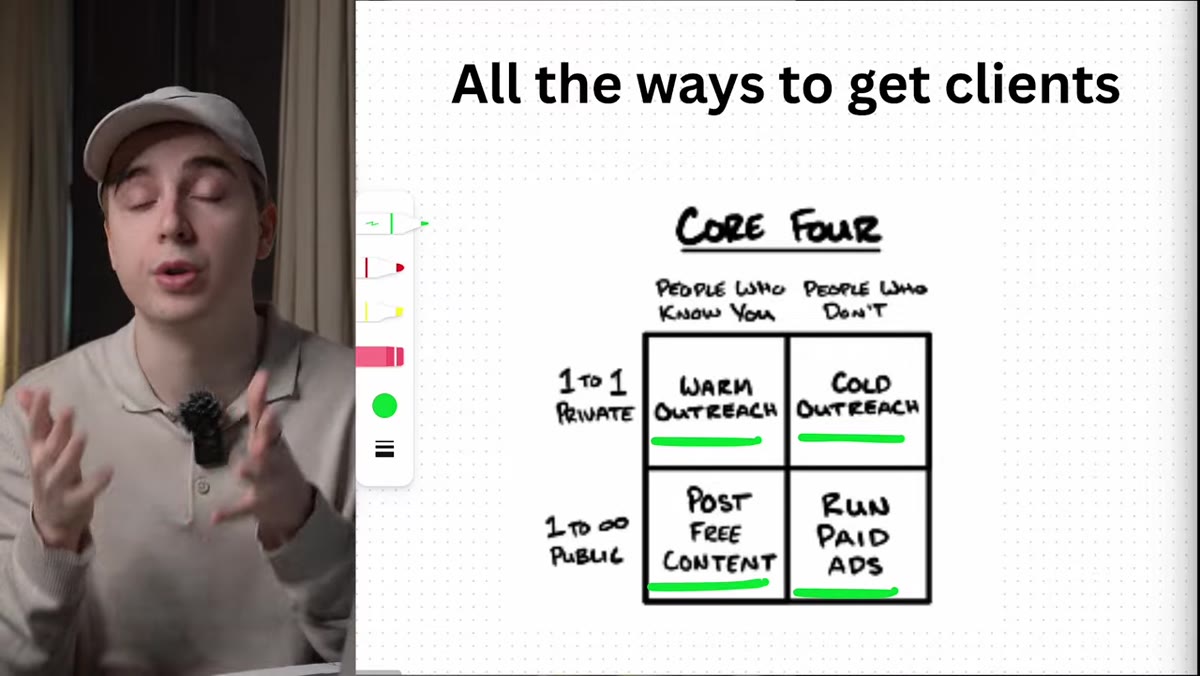
Cold outreach is reaching out one-on-one to people who do not know you yet. This might be local businesses you want to work with, brands that fit your style, or event planners in your city. Hugo’s key point is that you should not jump here until you have genuinely exhausted your warm network. The reason is that cold outreach requires more refinement. Your messaging needs to be tighter, your offer needs to be clearer, and your portfolio needs to do more heavy lifting because there is no existing trust to lean on. Use what you learn from warm outreach conversations to sharpen your pitch before you take it to strangers.
Hugo defining cold outreach as one-on-one private contact
Cold outreach is reaching out one-on-one to people who do not know you yet. This might be local businesses you want to work with, brands that fit your style, or event planners in your city. Hugo’s key point is that you should not jump here until you have genuinely exhausted your warm network. The reason is that cold outreach requires more refinement. Your messaging needs to be tighter, your offer needs to be clearer, and your portfolio needs to do more heavy lifting because there is no existing trust to lean on. Use what you learn from warm outreach conversations to sharpen your pitch before you take it to strangers.
Step 5: Add Free Content as a Long-Term Layer
 Hugo describing posting content to reach a group of people
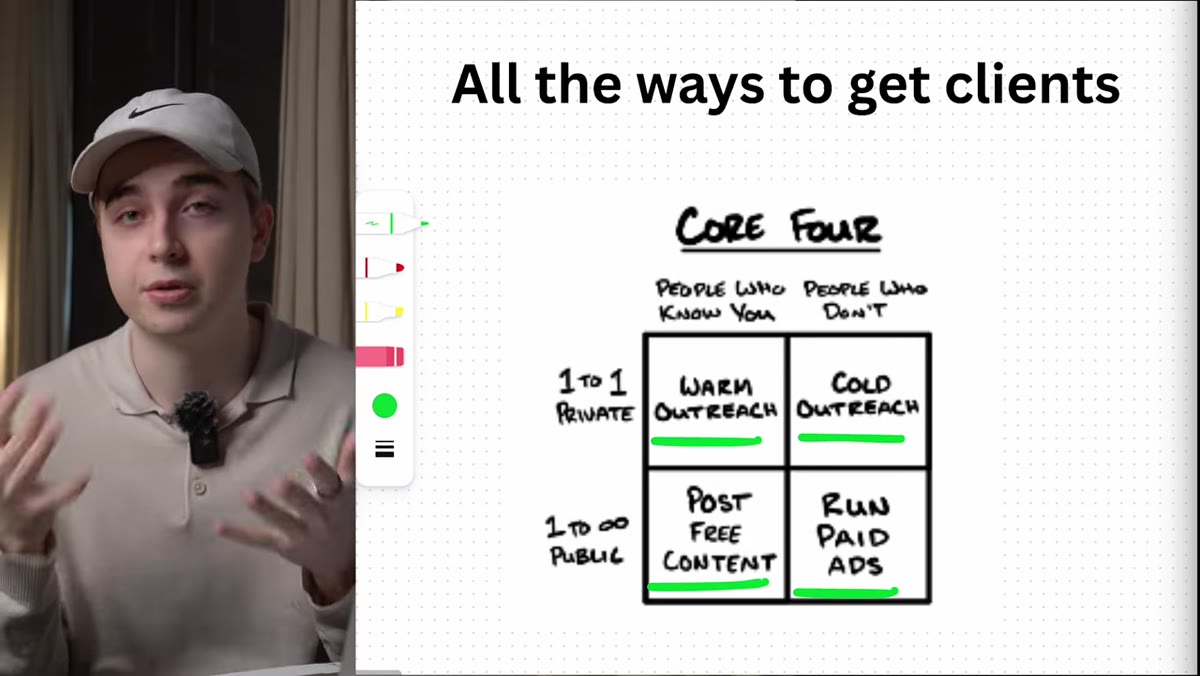
Posting content on social media puts you in front of a group of people rather than individuals, but Hugo flags two important limits. Reach is not guaranteed, meaning the algorithm decides who sees your work, and it is not precisely targeted, meaning you may attract people who love your photos but have no budget or no need for your specific service. This does not mean content is useless. It absolutely builds trust and authority over time. But it is a slow burn, and it should not be your primary client acquisition method when you are still building your pipeline. Think of it as a compounding investment, not a faucet you can turn on when you need work.
Hugo describing posting content to reach a group of people
Posting content on social media puts you in front of a group of people rather than individuals, but Hugo flags two important limits. Reach is not guaranteed, meaning the algorithm decides who sees your work, and it is not precisely targeted, meaning you may attract people who love your photos but have no budget or no need for your specific service. This does not mean content is useless. It absolutely builds trust and authority over time. But it is a slow burn, and it should not be your primary client acquisition method when you are still building your pipeline. Think of it as a compounding investment, not a faucet you can turn on when you need work.
Step 6: Use Paid Ads Only When You Are Ready to Scale
 Hugo explaining ads reach a targeted group with guaranteed reach
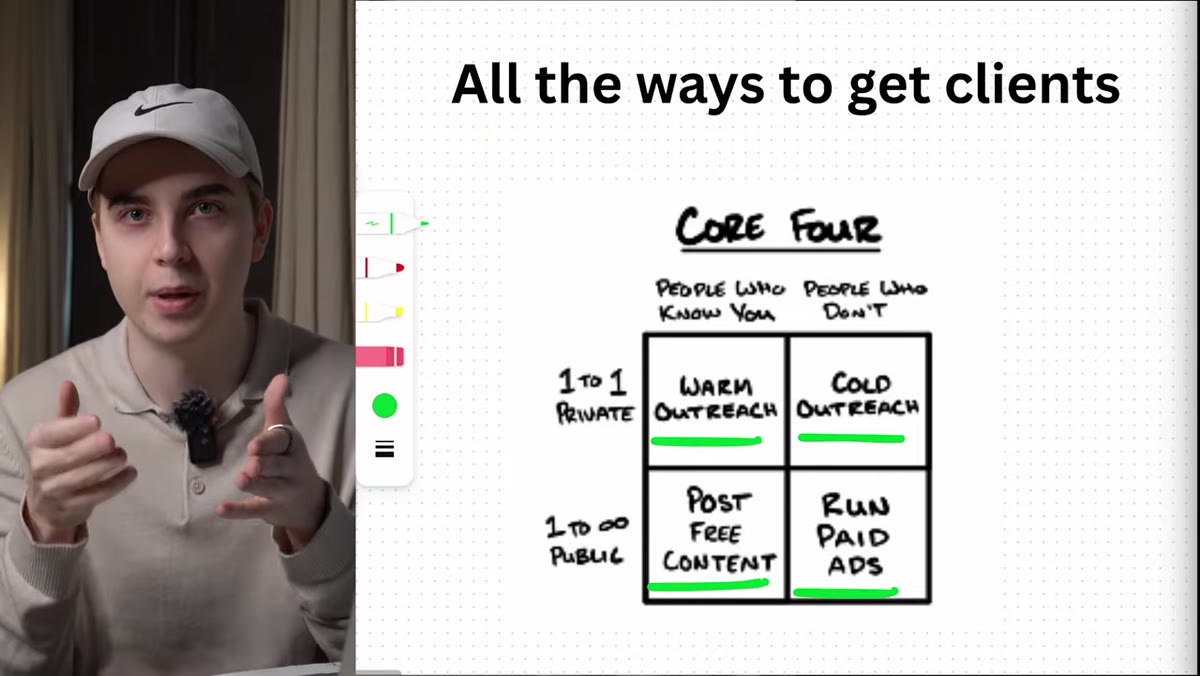
Paid ads give you something content does not: guaranteed, targeted reach. You can put your offer in front of exactly the kind of client you want, in exactly your city or industry. Hugo positions this as the last channel to turn on, not the first, because ads amplify what you already have. If your offer is weak or your messaging is unclear, ads will just accelerate your losses. But if you have validated your offer through warm and cold outreach, and you know what resonates with your ideal client, ads become a reliable way to scale that result. Do not skip to this step early just because it feels more “professional” than sending personal messages.
Hugo explaining ads reach a targeted group with guaranteed reach
Paid ads give you something content does not: guaranteed, targeted reach. You can put your offer in front of exactly the kind of client you want, in exactly your city or industry. Hugo positions this as the last channel to turn on, not the first, because ads amplify what you already have. If your offer is weak or your messaging is unclear, ads will just accelerate your losses. But if you have validated your offer through warm and cold outreach, and you know what resonates with your ideal client, ads become a reliable way to scale that result. Do not skip to this step early just because it feels more “professional” than sending personal messages.
What I’d Add From My Own Studio
Hugo’s framework is clean and correct, and the sequencing matters more than people realize. What I would add is that warm outreach works even better when you give people something specific to respond to. A vague “let me know if you need a photographer” gets vague results. When I relaunched my headshot packages last year, I messaged former clients with a specific offer, a limited number of spots, a clear price, and a deadline. My response rate was about three times higher than my previous “just checking in” style messages. The specificity does the work. People do not want to figure out whether your offer is relevant to them. Make it obvious.
The single most important shift in this tutorial is the permission it gives you to stop being passive. Your photography can be exceptional and still fail commercially if you treat client acquisition as something that just happens. The Core 4 gives you a real structure, and starting with your warm network gives you the fastest path to early momentum without needing a big following, a big ad budget, or a viral post.
Watch the full tutorial on YouTube to hear Hugo walk through the complete Client Flow System, including how to convert the clients you find once you have their attention.
Comments (1)
Simple but effective. Sometimes that's all you need.
Leave a Comment