I had a client last spring, a boutique hotel in the Keys, who wanted environmental shots for their redesigned website. I spent two mornings out there. Golden hour, perfect light, technically clean exposures. When I delivered the gallery, their creative director said something that stuck with me: “These are beautiful, but they don’t make me feel anything.”
She wasn’t wrong. I knew it before she said it. The images looked like stock photos. Competent, forgettable.
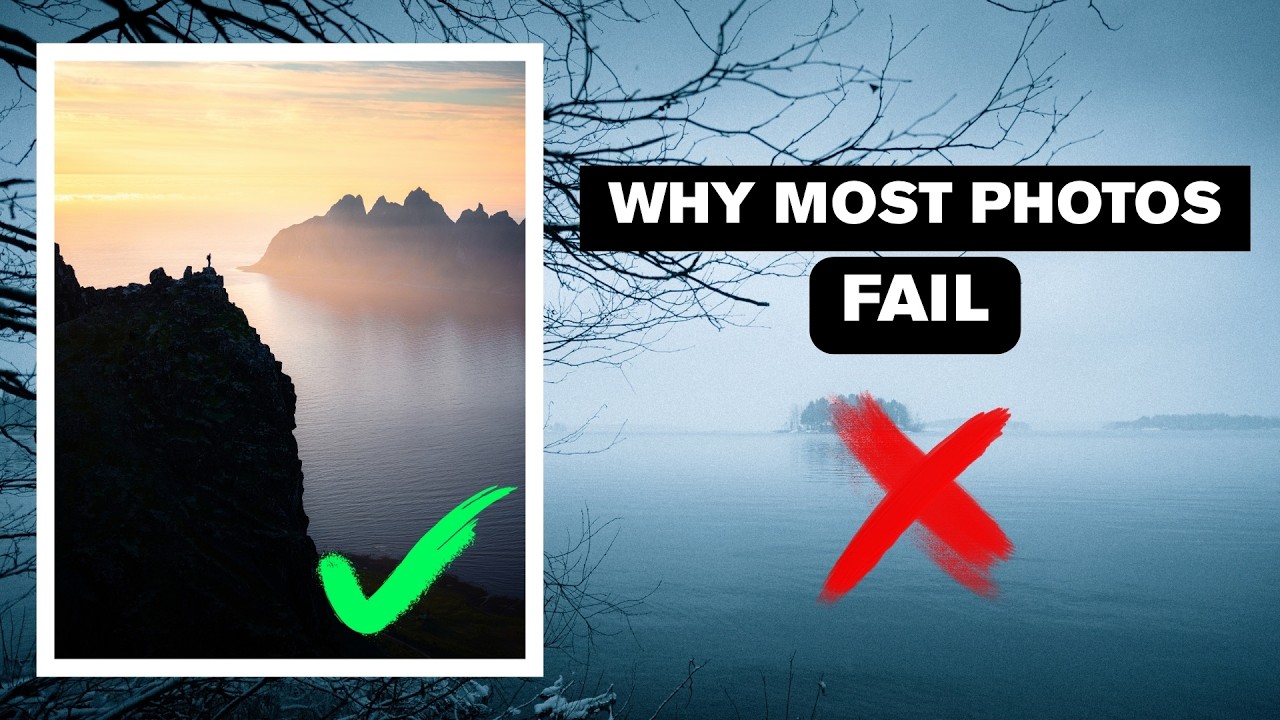
That feedback sent me back into research mode, and eventually I found myself watching Hugo Korhonen break down the single biggest mistake landscape photographers make. His answer wasn’t about gear, settings, or even light. It was about whether your photo is actually telling a story.
The Lie We Tell Ourselves About “Good Light”
Most of us were taught that great landscape photography is about being in the right place at the right time. Show up at golden hour, find something pretty, nail the exposure. Done. That checklist produces technically correct images constantly, and technically correct images almost never move people.
Hugo’s argument is sharper than that. He says the real problem is that most photographers are capturing scenes instead of telling stories. There is a difference, and once you see it, you can’t unsee it. A scene is what was in front of you. A story is why the viewer should care.
This is where his core framework comes in.
What the Story Triangle Actually Is
Hugo introduces a model he calls the Story Triangle, and it has three points: subject, environment, and mood. The argument is that a compelling landscape photograph needs all three working together deliberately. Remove any one of them and the image collapses into decoration.
The subject is not just “the mountain” or “the lake.” It is the specific element you are directing the viewer’s eye toward, and it needs to be unambiguous. If someone looks at your photo and cannot identify the subject in the first two seconds, you have lost them.
The environment is the context that gives the subject meaning. A lone tree in a field reads completely differently than a lone tree at the edge of a cliff. Same subject, opposite emotional weight. The environment is doing narrative work whether you intend it to or not, so you might as well be intentional about it.
Mood is the piece most photographers ignore completely. Mood is achieved through decisions: time of day, weather, color temperature, negative space, and crucially, what you leave out of the frame. Hugo makes the point that inclusion is easy and exclusion is the actual skill. Every element you leave in the frame is a vote for a particular emotional tone. Every element you remove is a vote too.
The triangle only functions when all three are in conversation with each other. A strong subject in a contradictory environment communicates nothing. A beautiful mood with no clear subject produces the kind of image my hotel client described: pretty but emotionally empty.
How to Apply This Before You Even Raise the Camera
The practical shift Hugo is recommending happens before you shoot, not in post. He suggests asking three questions at the location, out loud if you have to:
What is my subject, exactly? Not the general scene but the specific anchor point.
What does this environment tell me about that subject? Is it threatening, peaceful, isolating, expansive?
What single emotion do I want the viewer to feel? Name it. If you cannot name it, you are not ready to shoot.
These questions sound simple. They are not easy. Most of us have trained ourselves to react to light and move fast. Slowing down to answer three questions before lifting the camera feels counterintuitive, especially when the light is changing. But the discipline is the point. The photographers whose work consistently stops people cold are not luckier. They are more intentional.
Where I Would Push Back Slightly
Hugo’s framework is built around single-image storytelling, which is absolutely the right foundation. But in commercial and editorial work, I find that the Story Triangle often needs to be applied across a series rather than to each image in isolation. That hotel project I mentioned? When I went back and reshot it, I stopped trying to make every individual frame carry the full emotional weight. Instead I let some images handle subject, some handle environment, and a few do the heavy lifting on mood. Together they told a coherent story about what it feels like to stay there. Individually some of those frames would have felt incomplete by Hugo’s criteria.
That is not a flaw in the framework. It is just a reminder that the underlying principle, that emotion requires intention, scales up to multi-image storytelling just as well as it applies to a single shot. Know the rules well enough to know when to apply them differently.
The Only Question That Matters Before You Press the Shutter
Every technically proficient photograph that fails to move anyone has the same root cause: the photographer knew how to capture but not what to say. Hugo’s Story Triangle gives you the vocabulary to close that gap. Name your subject. Understand what your environment is saying about it. Commit to a single emotion before you shoot.
That one shift, from capturing scenes to constructing stories, is the difference between a portfolio that impresses people and work that actually resonates with them.
Watch the full video for Hugo’s visual examples. Seeing the before-and-after comparisons he walks through makes the subject-environment-mood relationship click faster than any written description can: https://www.youtube.com/watch?v=n-jbJmV6uXo
Comments (6)
I've watched a dozen tutorials on this and yours is the clearest by far.
I've been looking for exactly this kind of tutorial. Perfect timing.
Love this. I referenced a similar technique in one of my recent posts. Always good to see other perspectives.
The before and after really sells it. Incredible difference.
Quality content like this is rare. Keep it up.
Great breakdown. The step-by-step approach really helps.
Leave a Comment