I used to think the ceiling on what I could charge was set by the market. Whatever other Miami portrait photographers were charging, I’d land somewhere in that range and call it reasonable. Then I watched my parents run their photography business for fifteen years, always busy, always broke, and I made a quiet vow that I wouldn’t repeat their mistake. They shot beautifully. They just never raised their prices.
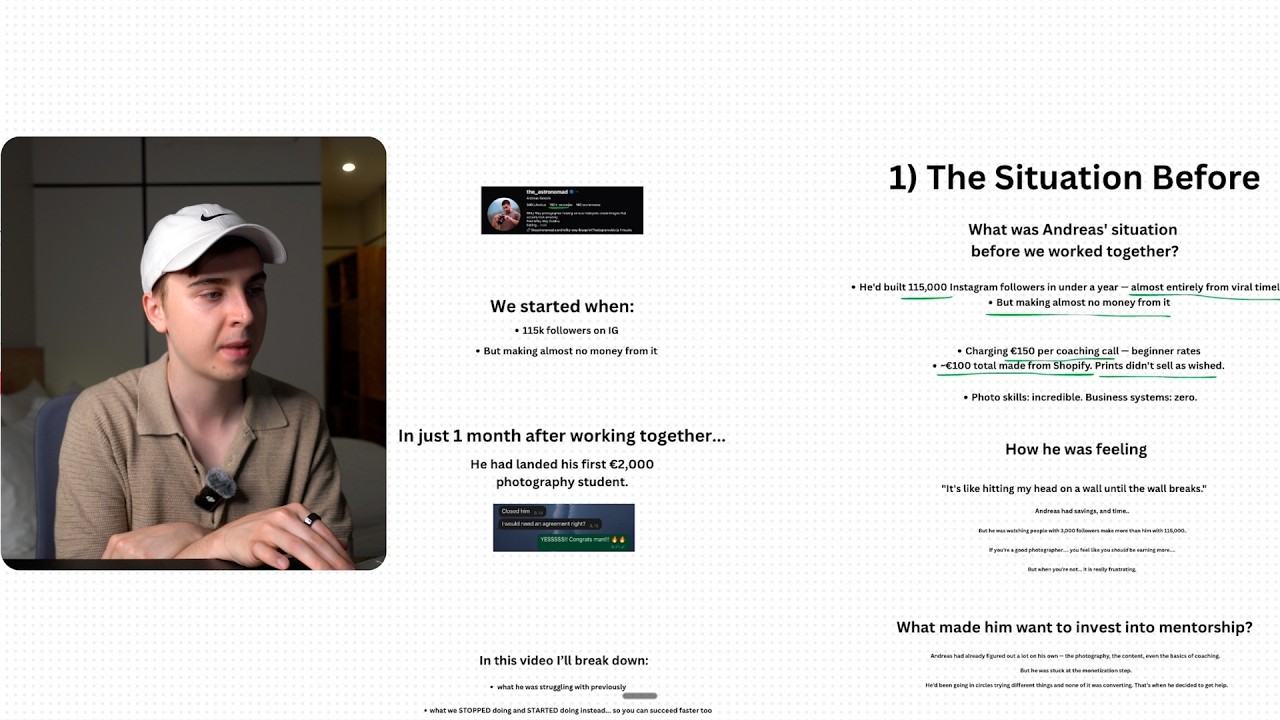
That backstory is why I stopped cold when I came across Hugo Korhonen’s breakdown of his $2,000 photography coaching offer. Not because the number is shocking, but because the structure behind it is something most photographers never bother to build. They either charge too little for their time or they throw together a vague “mentorship” with no clear deliverables and wonder why it doesn’t convert.
Why Most Photography Coaching Feels Cheap Even When It Isn’t
The problem isn’t the price point. It’s the packaging. A $2,000 offer that isn’t clearly defined looks identical to a $200 one from the client’s perspective. No defined outcomes, no clear timeline, no logical reason for the number. Buyers feel the uncertainty even if they can’t name it, and they hesitate or walk away.
Hugo’s approach solves this directly. He isn’t selling “coaching sessions.” He’s selling a specific transformation over a specific window of time, with accountability structures built in. That distinction changes everything about how a prospect evaluates the offer.
The Architecture of the Offer Itself
In this Hugo Korhonen tutorial, he breaks his $2,000 offer down into components that stack logically. The core is a defined period of access, typically a set number of weeks, with a clear goal attached. In his case, that goal is helping photographers build a story-driven business and get to a point where they’re earning consistently from their craft.
The delivery mechanism matters as much as the content. He uses a combination of one-on-one sessions and ongoing touchpoints between calls, which keeps clients moving instead of going quiet between sessions. That ongoing accountability is what separates a coaching offer from a course or a one-time consultation.
He also positions the offer around a specific outcome rather than hours of his time. This is the shift that lets the price hold. When you sell time, $2,000 feels like a lot. When you sell a result, $2,000 is evaluated against what that result is worth to the buyer, which is a much stronger calculation for the seller.
How He Qualifies Buyers Before They Even See the Price
One of the most practically useful things Hugo demonstrates is the front-end qualification process. He doesn’t post the offer publicly and wait for anyone to buy. Prospects DM him to apply, then go through a brief assessment before any sales conversation happens.
This does two things. First, it filters out people who aren’t serious. Second, it frames the offer as selective, which is accurate and also strategically sound. When someone completes an application to work with you, they’ve already invested something. They arrive at the conversation more committed than someone who clicked a buy button.
The assessment questions are also doing selling work. They ask the prospect to articulate where they are, where they want to be, and what’s blocking them. By the time Hugo talks to them, they’ve already named their own problem out loud, which makes his offer a much easier yes.
I use a version of this in my portrait studio for high-ticket shoots. My client inquiry form asks specific questions about what they want to feel when they look at these photos, and what the occasion means to them. By the time we talk, I’m not selling. I’m confirming.
What I’d Do Differently in a Studio-Based Context
Here’s where I’d adjust the model for photographers who aren’t building a coaching business but want to apply the same structural thinking to their service offers.
The outcome-anchored framing works for any photography business. Instead of selling “a half-day portrait session,” you’re selling “a complete personal brand image library for a quarter of content.” Same deliverables, different frame, different price tolerance from the buyer.
The piece that requires more thought in a studio context is the qualification step. Coaching clients expect an application process. Portrait clients generally don’t, and if you make it feel too formal, you create friction that loses casual inquiries before they warm up. My solution has been to make the intake form feel like concierge service rather than a filter. You’re not screening them out. You’re customizing their experience from the first touchpoint.
The accountability structure Hugo builds into his coaching doesn’t directly translate either. But the underlying principle does. What keeps a client moving toward the outcome they bought? For a coaching client, it’s check-ins. For a portrait client, it’s a guided timeline with clear steps from booking to delivery. I have a 47-point client experience checklist that essentially does this. Every step is mapped so nothing falls through and the client always knows what’s coming next.
The One Thing That Actually Makes This Work
The price is not the product. The transformation is the product, and the price has to be attached to the transformation, not to your time or your deliverables. Hugo Korhonen builds his $2,000 offer around a specific, believable outcome for a specific type of photographer, and that’s why it can hold that price point without apology.
If you’ve been undercharging, the fix isn’t just raising your rates. It’s rebuilding how you describe and deliver what you sell. Watch the full tutorial to see Hugo walk through this offer structure in his own words, because seeing how he talks about it is half the lesson.
Comments
Leave a Comment