I grew up watching my parents run a photography business that stayed flat for years. Not because the work wasn’t good — it was excellent — but because they never raised their prices. They kept charging what felt “safe,” and safe kept them stuck. That pattern was so burned into me that when I started my own studio, I almost repeated it. I undercharged for years before I finally got serious about pricing, restructured my offers, and doubled my income in twelve months. So when I came across this Hugo Korhonen tutorial breaking down how he helped a photographer named Andreas build and sell a 2,000 euro coaching offer, I stopped everything and watched it twice.
Watch the full tutorial on YouTube
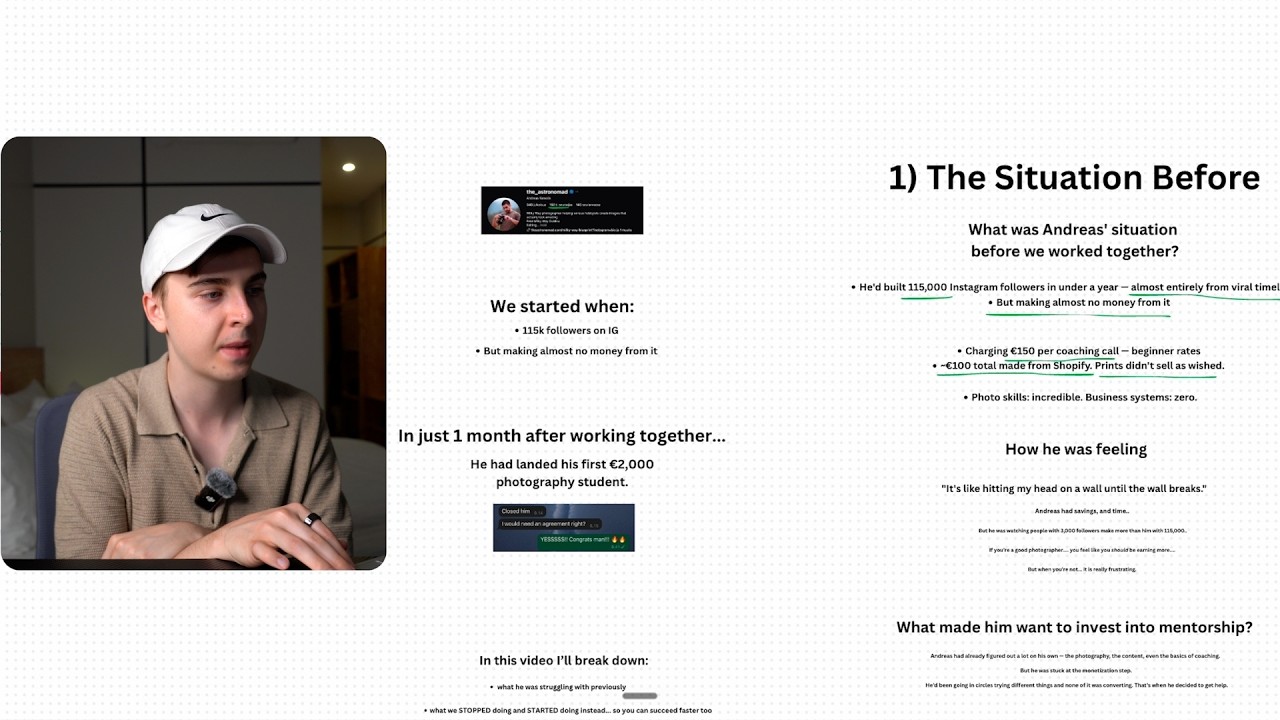
The story Korhonen tells is one I recognize. Andreas had built 115,000 Instagram followers in under a year, his photography was genuinely world-class, and he was making almost nothing. He had tried Shopify (earned 100 euros total), experimented with print sales, and was charging 150 euros per one-off coaching call with no structure around it. The skills and the audience existed. The business system did not. What this tutorial walks through is exactly how that gap gets closed — and the steps are specific enough that you can apply them directly to your own situation.
Step 1: Diagnose Why Your Audience Isn’t Converting
 Andreas’s Instagram showing 115K followers but minimal revenue
Before you can fix a monetization problem, you have to understand what kind of audience you actually have. Korhonen’s first point is blunt: follower counts mean very little if your audience came from content that doesn’t connect to what you want to sell. In Andreas’s case, most of his growth came from viral time-lapse videos. Impressive content, but it attracted viewers who wanted to watch pretty videos, not learn photography. A smaller, more targeted audience will outperform a large, unfocused one almost every time.
Andreas’s Instagram showing 115K followers but minimal revenue
Before you can fix a monetization problem, you have to understand what kind of audience you actually have. Korhonen’s first point is blunt: follower counts mean very little if your audience came from content that doesn’t connect to what you want to sell. In Andreas’s case, most of his growth came from viral time-lapse videos. Impressive content, but it attracted viewers who wanted to watch pretty videos, not learn photography. A smaller, more targeted audience will outperform a large, unfocused one almost every time.
Ask yourself honestly: what did the people following you come for? If the answer isn’t directly related to a service or skill you want to sell, you have audience-content misalignment, and no pricing strategy fixes that until you address it first.
Step 2: Stop Charging Per Call and Start Charging for a Transformation
 Discussion of 150 euro per-call pricing as “beginner rates”
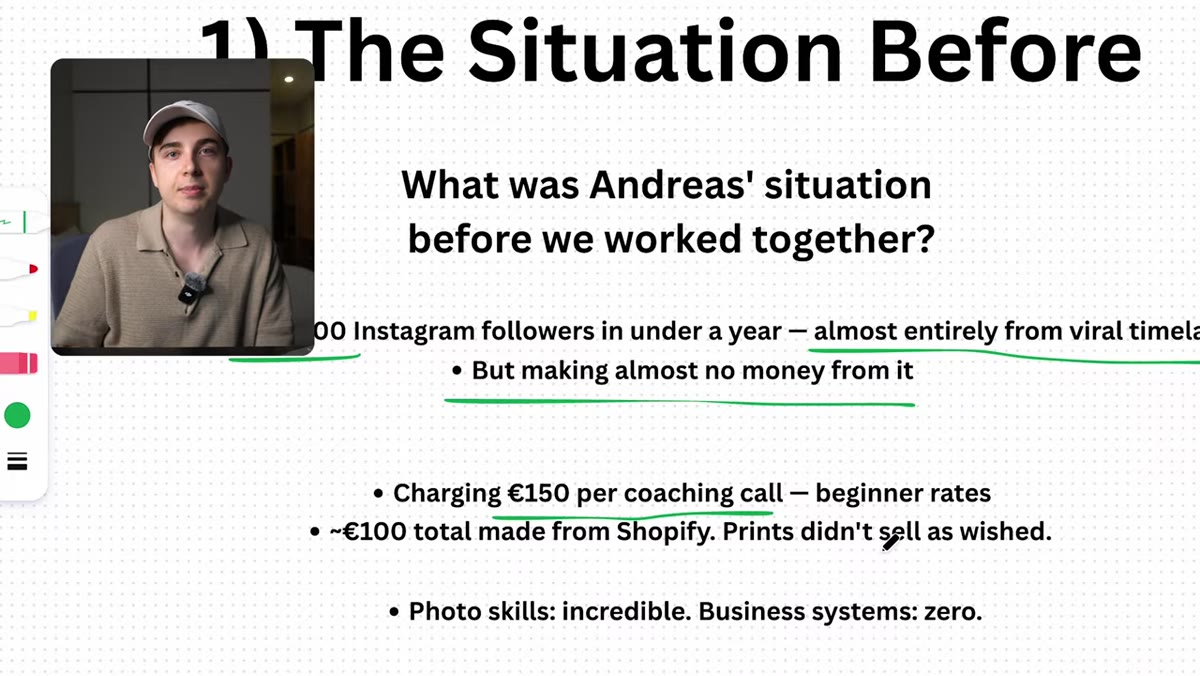
Korhonen is direct about this: charging 150 euros per individual coaching call is beginner pricing. It signals low confidence, creates no commitment from the client, and leaves no room for you to deliver a real result. A single call rarely changes anything for a student. What actually works is a structured program that takes someone from a defined starting point to a defined outcome.
Discussion of 150 euro per-call pricing as “beginner rates”
Korhonen is direct about this: charging 150 euros per individual coaching call is beginner pricing. It signals low confidence, creates no commitment from the client, and leaves no room for you to deliver a real result. A single call rarely changes anything for a student. What actually works is a structured program that takes someone from a defined starting point to a defined outcome.
The shift here isn’t just cosmetic. When you charge per call, you’re selling your time. When you charge for an outcome, you’re selling a result, and results justify dramatically higher prices. This is the structural move that made the 2,000 euro number possible. Without it, you’re always negotiating hours against dollars.
Step 3: Define the Specific Outcome Your Offer Delivers
 Korhonen outlining the coaching offer structure built for Andreas
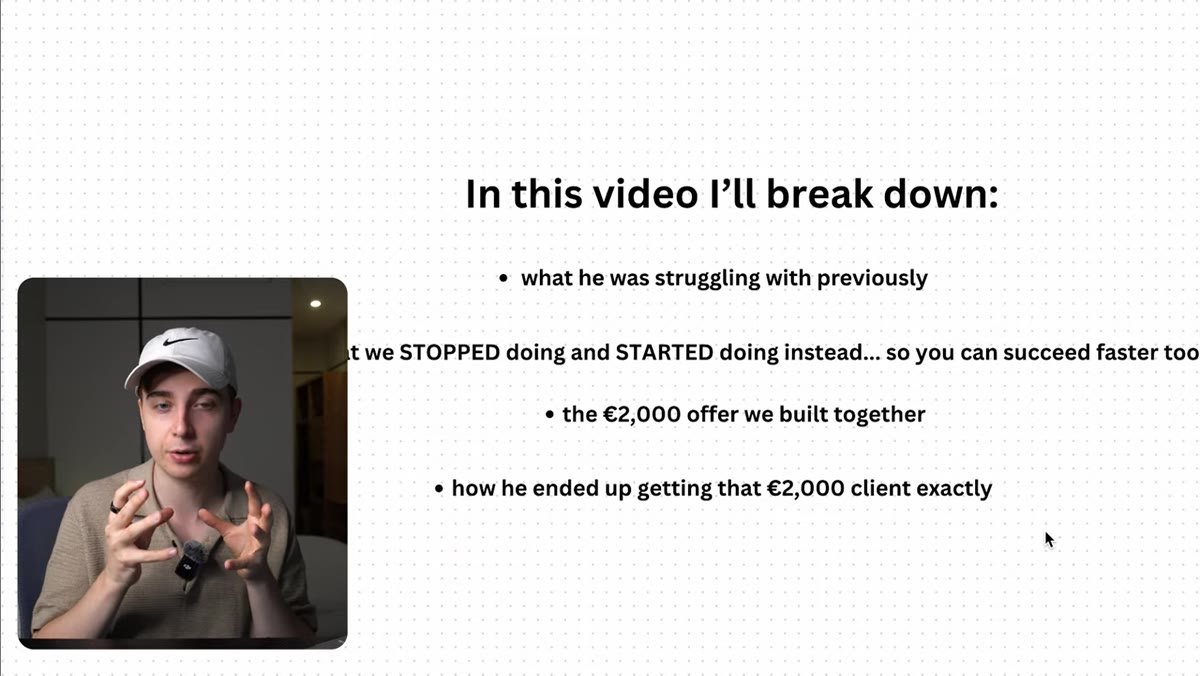
A high-ticket coaching offer needs a clearly stated transformation. Not “I’ll teach you photography” but “by the end of this program, you will be able to do X.” The more specific and measurable, the better. Korhonen built Andreas’s offer around a concrete photography skill set and business outcome, packaged as a multi-week engagement rather than a menu of individual calls.
Korhonen outlining the coaching offer structure built for Andreas
A high-ticket coaching offer needs a clearly stated transformation. Not “I’ll teach you photography” but “by the end of this program, you will be able to do X.” The more specific and measurable, the better. Korhonen built Andreas’s offer around a concrete photography skill set and business outcome, packaged as a multi-week engagement rather than a menu of individual calls.
When I redid my own mentorship pricing a few years ago, I went through this same exercise. I stopped listing what we’d cover and started leading with what clients would be able to do and charge after working with me. Enrollment went up and so did the average contract value. People don’t pay 2,000 dollars for education. They pay for a future state they want to reach.
Step 4: Price Based on the Value of the Outcome, Not Your Hourly Rate
 Korhonen explaining why 100 euros per call is baseline, not ceiling
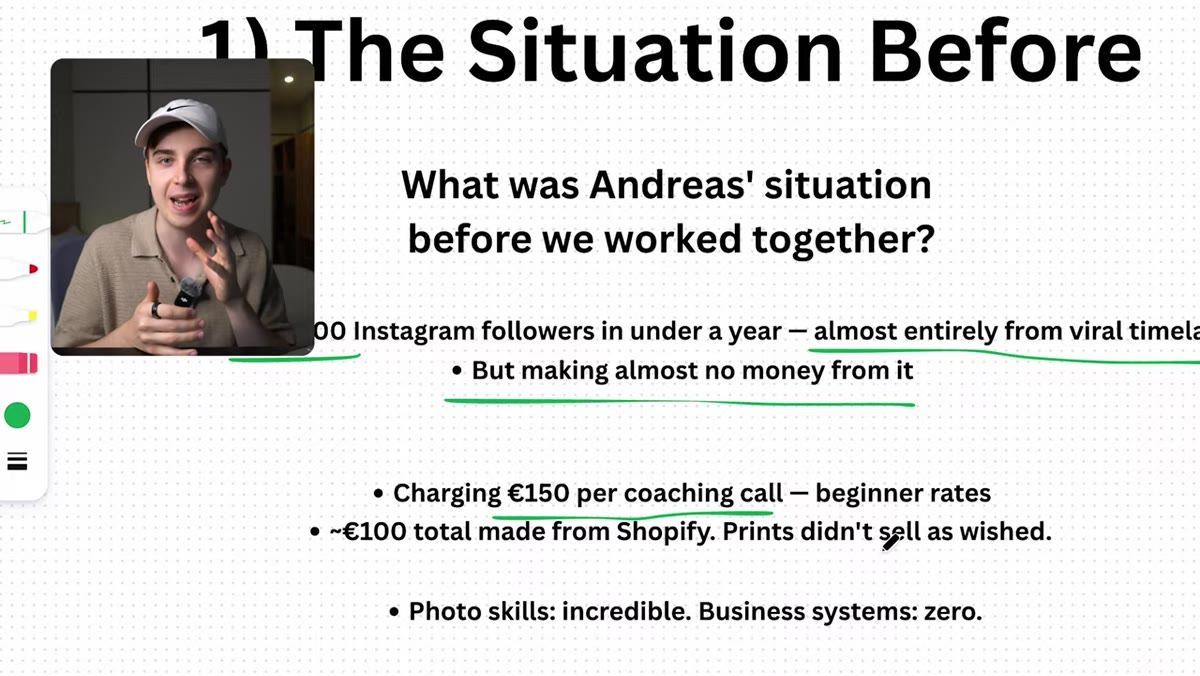
Korhonen makes a point here that I want to underline: nearly anyone with basic photography knowledge can charge 100 euros for their time. That’s not a business, that’s a favor with an invoice. The moment you build a framework around a real outcome, you’ve created something worth far more than the hours inside it.
Korhonen explaining why 100 euros per call is baseline, not ceiling
Korhonen makes a point here that I want to underline: nearly anyone with basic photography knowledge can charge 100 euros for their time. That’s not a business, that’s a favor with an invoice. The moment you build a framework around a real outcome, you’ve created something worth far more than the hours inside it.
Value-based pricing asks: what is this result worth to the person buying it? If your coaching helps a photographer land their first paid client, go full-time, or build a recurring revenue stream, the value to them is enormous. Two thousand euros for that outcome is not expensive. It’s proportionate. The number that feels scary to you as the seller often feels completely reasonable to a motivated buyer who has already tried to figure it out alone.
Step 5: Use a Sales Conversation, Not a Sales Page
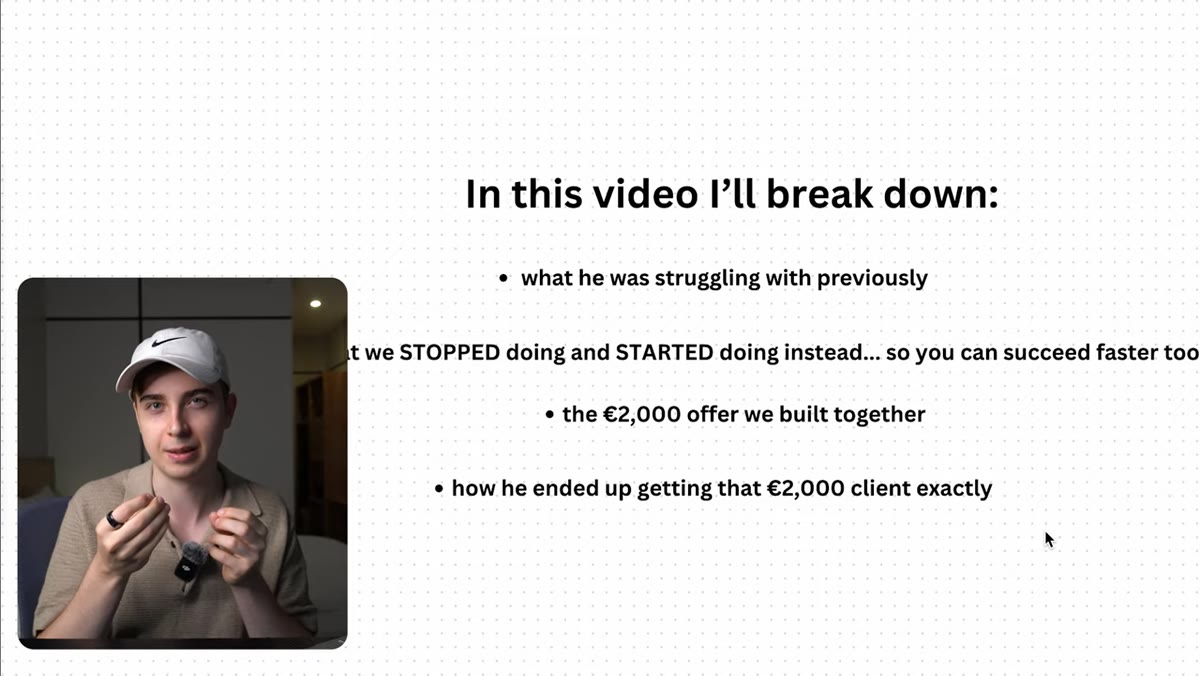 Breakdown of how Andreas landed the 2,000 euro client through direct conversation
The 2,000 euro client didn’t find Andreas through a funnel or a landing page. Korhonen walks through how the sale happened through a direct conversation, where Andreas could understand the prospect’s situation and connect it to the outcome the offer delivers. At this price point, that’s exactly right. High-ticket sales require trust, and trust gets built in conversation faster than it does on a webpage.
Breakdown of how Andreas landed the 2,000 euro client through direct conversation
The 2,000 euro client didn’t find Andreas through a funnel or a landing page. Korhonen walks through how the sale happened through a direct conversation, where Andreas could understand the prospect’s situation and connect it to the outcome the offer delivers. At this price point, that’s exactly right. High-ticket sales require trust, and trust gets built in conversation faster than it does on a webpage.
This doesn’t mean you need to be a salesperson in the traditional sense. It means you need to be genuinely curious about what the other person is struggling with, and clear about what your program does. If there’s a fit, the conversation closes itself. If there isn’t, you both save time.
What I’d Add From My Own Experience
The piece Korhonen doesn’t spend much time on, but that I think matters enormously, is what you do after someone says yes. I have a client experience checklist I built over years of trial and error. It has 47 items on it. It sounds obsessive, but it exists because early in my business I had clients who got good results and still didn’t refer anyone to me, simply because the experience felt disorganized. Delivering a result is necessary. Delivering it in a way that feels premium and intentional is what turns one client into five through word of mouth.
If you’re going to charge 2,000 dollars or euros for a coaching offer, your onboarding, communication cadence, and offboarding process need to match that price tag. Otherwise you’ve sold something you can’t sustainably repeat.
The single most important takeaway from this tutorial is that the gap between “talented photographer with followers” and “photographer making real money” is almost never a talent gap. It’s a packaging and positioning gap. Andreas had everything he needed except a structured offer and a price that reflected the value of what he was teaching. One month after closing that gap, he had a 2,400 USD client.
That timeline is real and it’s repeatable. If you want to see the full breakdown, including how Korhonen actually structured the offer and walked Andreas through the sale, watch the full tutorial on YouTube.
Comments (5)
I've watched a dozen tutorials on this and yours is the clearest by far.
Couldn't agree more. I've seen this make a huge difference in compositing work specifically.
Would love to see a follow-up going deeper into this topic.
This is going in my reference folder. Incredibly useful.
My workflow just got 10x faster. Not even kidding.
Leave a Comment