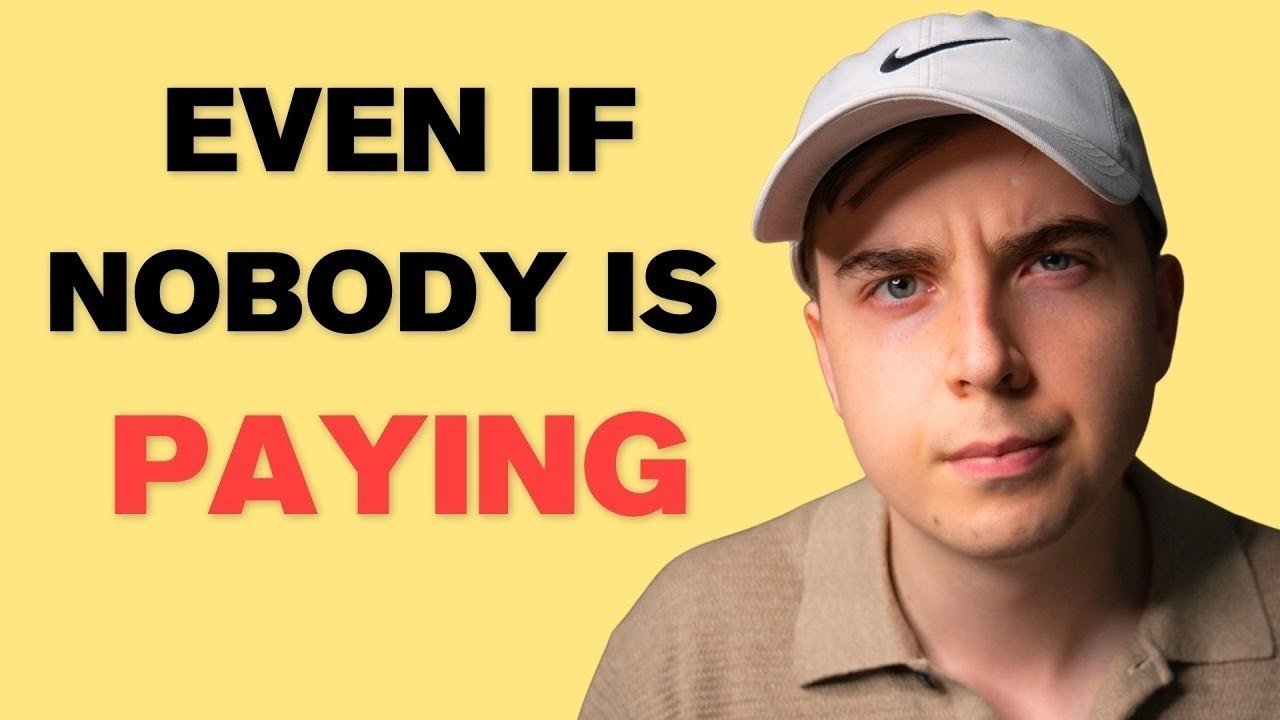
I watched my parents run a photography business for twelve years and never once raise their prices. Same session fee in year one as in year twelve. They were talented. They were booked. And they were exhausted, anxious, and eventually out of business. That experience sat in the back of my mind for a long time before I finally did something about it in my own studio. So when I came across Hugo Korhonen’s video on pricing, I wasn’t looking for permission. I was looking for a framework to articulate what I already knew but wasn’t applying consistently.
This tutorial gave me that, and then some.
Better Work Alone Will Not Save Your Business
The first thing Hugo addresses is the assumption that most photographers are operating under: that getting sharper technically will eventually translate into earning more money. It won’t. Not automatically.
This is the trap. You spend six months obsessing over your light ratios, buy a new prime lens, redo your editing presets, and then look at your bank account and wonder why nothing changed. Hugo makes the case that skill and pricing are separate disciplines. You can be genuinely excellent at your craft and still be dramatically undercharging, because pricing is not a photography decision. It is a business decision.
He points to a specific psychological pattern: skilled photographers often charge less than they could, not more. The reasoning behind it is almost counterintuitive. The more you care about the work, the more terrified you are that someone will say no, and the more you preemptively lower your prices to remove that risk. You start negotiating against yourself before a client has said a single word.
I did this for three years. My session fees were set at a number I thought people could “comfortably” afford, which is not a pricing strategy. That is a fear response.
The Actual Reason You Are Not Getting Clients
Hugo makes a point here that I think is the most valuable in the entire video, and it is one that photographers almost never want to hear: price is rarely the real reason clients are not booking.
When inquiries dry up or ghosting happens after a quote, most photographers immediately assume the price is too high. Hugo argues that in the majority of cases, the issue is much further upstream. It is a positioning problem. A visibility problem. A trust problem. Clients who cannot tell what makes you different from the photographer three ZIP codes over are not going to pull out a credit card regardless of what number you put on your pricing page.
He breaks this down into a simple diagnostic. If you are getting lots of inquiries but few bookings, that is a conversion problem, which can include pricing. If you are getting almost no inquiries at all, the price is not the issue. The issue is that not enough people know you exist or understand your value.
That distinction changed how I looked at my own funnel. I had months where I blamed my pricing and months where I thought I needed to lower my minimum spend. Looking back, the slow months were almost always visibility gaps, not pricing gaps.
You Do Not Have to Shoot More to Earn More
This is where the math becomes undeniable. Hugo walks through the arithmetic of what happens when you raise prices versus when you chase volume. If you are shooting eight sessions a month at $300 each, that is $2,400. Raise to $600, book four, and you have the same revenue with half the sessions. Raise to $900, book three, and you are already ahead, with more time, less physical output, and significantly less post-production hours eating into your week.
The numbers are not magic. They are just multiplication. But photographers routinely skip this calculation because the idea of raising prices feels like a gamble, while booking more sessions feels like hustle, and hustle feels safe.
What Hugo adds beyond the math is the quality-of-life argument. Fewer sessions means more time per client, which means a better experience, which means stronger referrals and reviews. The business compounds differently when you are not burning out on back-to-back weekend bookings.
I doubled my income in one year by applying exactly this logic. I raised my portrait session starting price and immediately took on fewer sessions. My first instinct was panic. Three months later, I was making more and working about 30 percent fewer hours. The compounding effect on client experience was real. I had time to actually show up for my clients instead of rushing from one location to the next.
One Place This Framework Needs Adjustment
Here is my honest caveat, because no framework is universal.
Hugo’s approach works extremely well for photographers who are already getting some traction, meaning they have a small body of work, some social proof, and an identifiable niche. For photographers who are genuinely brand new with zero portfolio and zero testimonials, raising prices before building any trust is difficult. Not impossible, but difficult.
What I would add is this: the positioning work has to come first. You cannot charge premium prices if your online presence looks identical to every other photographer in your city. Raise prices and your positioning at the same time. A higher price with no corresponding story, visual identity, or differentiated offer is just a higher number on a page nobody trusts yet.
When to Actually Make the Move
Hugo closes by addressing the timing question directly: when is the right moment to raise your prices? His answer is straightforward. You raise them when you are consistently booked and turning clients away. Demand exceeding supply is your market telling you the price is too low.
But he also makes a quieter point that I think is worth sitting with. Waiting for the “perfect moment” to raise prices is often just fear wearing a practical disguise. There is rarely a moment that feels fully safe. The move itself creates the momentum.
Your pricing is not just a number. It is a signal to every potential client about the kind of experience they should expect. Charge accordingly.
Watch the full video for Hugo’s complete breakdown, including how he frames the pricing conversation with clients and why the objection you fear most almost never shows up the way you expect.
Comments
Leave a Comment