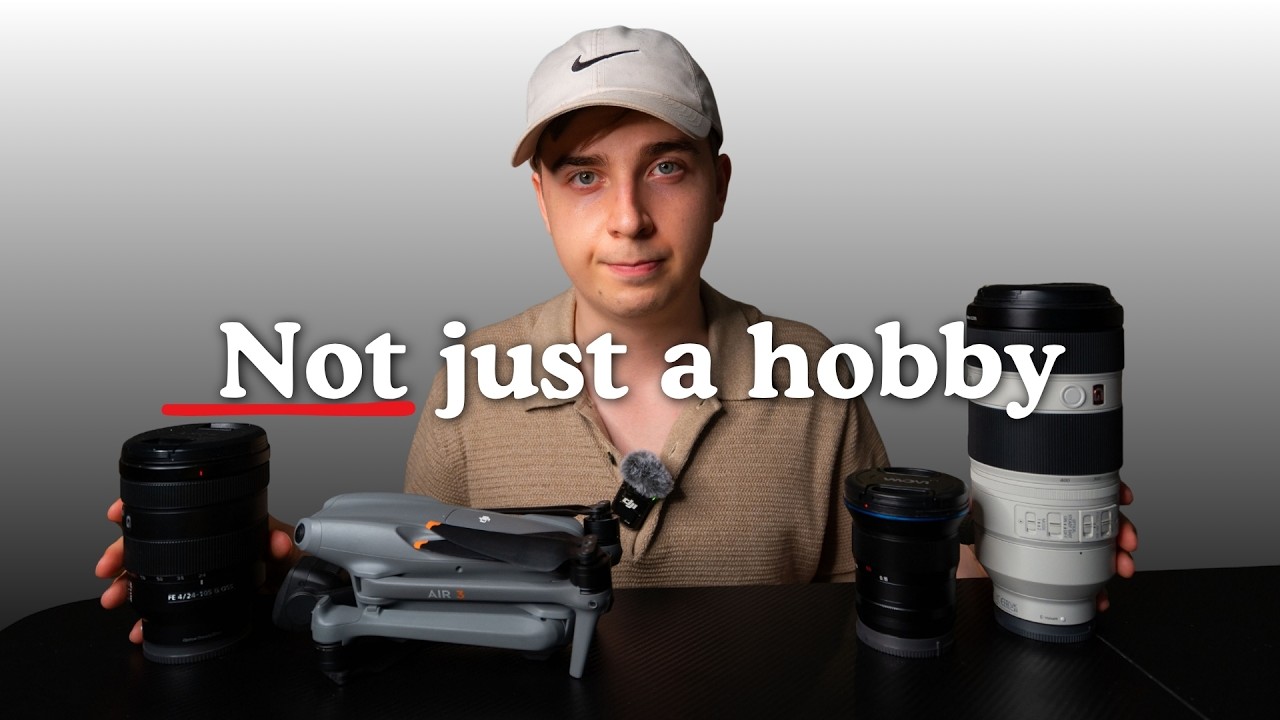
I grew up watching my parents run a portrait studio on pure talent and zero business strategy. They were gifted. They were also constantly stressed about money, because they never solved the fundamental problem underneath all the camera skills: they didn’t understand what they were actually selling. I didn’t fully understand it either until years into running my own studio, when I started dissecting what separated photographers who thrived from photographers who just stayed busy. That’s why when I came across this Hugo Korhonen tutorial breaking down the five mistakes stopping photographers from making consistent income, I sat with it for a while. Not because it was news to me, but because Korhonen articulates the pattern with unusual precision. Watch the full tutorial on YouTube before or after reading this - it’s worth your full attention.
The frustrating truth Korhonen opens with is that most working photographers aren’t more talented than you. They don’t have better gear. What they have is a clearer understanding of how business actually works. He spent the early part of his career getting compliments from potential clients and no contracts. Sound familiar? It did to me. Here’s the breakdown of the five mistakes, in the order he addresses them, with the practical shifts behind each one.
Step 1: Stop Selling Photos. Start Solving a Problem.
 Photographer explaining why “offering photos” is the wrong framing
The first and most common mistake is framing your service as “photos.” Photos are an output. They are not a solution. Businesses and individuals pay money to solve problems, and if you can’t articulate what problem you’re solving, you will keep hearing “we love your work, but…” Korhonen’s instruction here is direct: get specific about the problem your photography resolves for a client. A restaurant owner doesn’t need photos - they need content that drives reservations. A personal brand client doesn’t need headshots - they need images that make them look credible enough to charge premium prices. The more expensive the problem you solve, the more you can charge. Start by writing down three measurable outcomes your work creates for clients. That’s your actual offer.
Photographer explaining why “offering photos” is the wrong framing
The first and most common mistake is framing your service as “photos.” Photos are an output. They are not a solution. Businesses and individuals pay money to solve problems, and if you can’t articulate what problem you’re solving, you will keep hearing “we love your work, but…” Korhonen’s instruction here is direct: get specific about the problem your photography resolves for a client. A restaurant owner doesn’t need photos - they need content that drives reservations. A personal brand client doesn’t need headshots - they need images that make them look credible enough to charge premium prices. The more expensive the problem you solve, the more you can charge. Start by writing down three measurable outcomes your work creates for clients. That’s your actual offer.
Step 2: Fix Your Client Targeting Before Anything Else
 Discussion of targeting the wrong clients as a core revenue mistake
Korhonen’s second mistake is going after the wrong clients entirely. Most photographers default to whoever seems accessible - friends, local small businesses, people who’ve already expressed interest. But accessibility isn’t the same as fit. Wrong clients drain your time, undervalue your work, and rarely refer you to anyone better. The right client has a real budget, a genuine problem your photography solves, and a business context where visual content is already understood as an investment. Before your next round of outreach, define your ideal client in terms of industry, company size, and the specific outcome they need. If you can’t picture a real person with a real budget, you don’t have a target yet.
Discussion of targeting the wrong clients as a core revenue mistake
Korhonen’s second mistake is going after the wrong clients entirely. Most photographers default to whoever seems accessible - friends, local small businesses, people who’ve already expressed interest. But accessibility isn’t the same as fit. Wrong clients drain your time, undervalue your work, and rarely refer you to anyone better. The right client has a real budget, a genuine problem your photography solves, and a business context where visual content is already understood as an investment. Before your next round of outreach, define your ideal client in terms of industry, company size, and the specific outcome they need. If you can’t picture a real person with a real budget, you don’t have a target yet.
Step 3: Audit Your Outreach for These Specific Errors
 Korhonen walking through common outreach mistakes photographers make
The third mistake lives in how photographers approach outreach - and it’s where a lot of technically strong photographers lose deals they should be winning. The most common errors Korhonen identifies: leading with your portfolio instead of their problem, sending generic messages that read like mass emails, and following up poorly or not at all. Good outreach is specific. It references something real about the prospect’s business and connects it directly to a result you can deliver. A message that says “I noticed your website is using stock photography - I work with brands in your space to replace that with content that actually converts” will outperform any “I’d love to work with you” pitch every single time. Write outreach messages as if you’re sending one, not broadcasting to a list.
Korhonen walking through common outreach mistakes photographers make
The third mistake lives in how photographers approach outreach - and it’s where a lot of technically strong photographers lose deals they should be winning. The most common errors Korhonen identifies: leading with your portfolio instead of their problem, sending generic messages that read like mass emails, and following up poorly or not at all. Good outreach is specific. It references something real about the prospect’s business and connects it directly to a result you can deliver. A message that says “I noticed your website is using stock photography - I work with brands in your space to replace that with content that actually converts” will outperform any “I’d love to work with you” pitch every single time. Write outreach messages as if you’re sending one, not broadcasting to a list.
Step 4: Stop Over-Investing in Passive Marketing Before You Have Traction
 Hugo explaining why websites and social media stall early-stage photographers
This is the one that stings a little, because most of us have spent real time here. Korhonen’s fourth mistake is pouring energy into a website, posting consistently on social media, or obsessing over gear upgrades before you have actual clients. None of those things are wrong in themselves, but they become avoidance behaviors when you use them instead of direct outreach. A perfect website does not replace a conversation. I spent three weeks redesigning my studio’s service page in year two when what I actually needed was to send twelve targeted emails to local businesses. Active revenue-generating actions - outreach, follow-ups, referral requests - have to come before passive marketing infrastructure. Build your business first. Polish it second.
Hugo explaining why websites and social media stall early-stage photographers
This is the one that stings a little, because most of us have spent real time here. Korhonen’s fourth mistake is pouring energy into a website, posting consistently on social media, or obsessing over gear upgrades before you have actual clients. None of those things are wrong in themselves, but they become avoidance behaviors when you use them instead of direct outreach. A perfect website does not replace a conversation. I spent three weeks redesigning my studio’s service page in year two when what I actually needed was to send twelve targeted emails to local businesses. Active revenue-generating actions - outreach, follow-ups, referral requests - have to come before passive marketing infrastructure. Build your business first. Polish it second.
Step 5: Design Your Offer to Recur
 Korhonen outlining why one-off shoots create income instability
One-off shoots are exhausting. You close a job, deliver it, and then start the whole sales process over again from zero. Korhonen’s fifth mistake is building a service model with no natural reason for clients to come back. The fix is designing offers that recur - monthly content packages for businesses, quarterly brand refresh shoots, ongoing social media content retainers. A client on a retainer generates stable income without requiring you to re-sell them every month. When I restructured part of my studio’s work around monthly portrait packages for personal brands, my revenue variability dropped significantly. Even one or two recurring clients changes what your month feels like financially. Ask yourself: what does this client need on an ongoing basis, and how can I structure my offer around that need?
Korhonen outlining why one-off shoots create income instability
One-off shoots are exhausting. You close a job, deliver it, and then start the whole sales process over again from zero. Korhonen’s fifth mistake is building a service model with no natural reason for clients to come back. The fix is designing offers that recur - monthly content packages for businesses, quarterly brand refresh shoots, ongoing social media content retainers. A client on a retainer generates stable income without requiring you to re-sell them every month. When I restructured part of my studio’s work around monthly portrait packages for personal brands, my revenue variability dropped significantly. Even one or two recurring clients changes what your month feels like financially. Ask yourself: what does this client need on an ongoing basis, and how can I structure my offer around that need?
Step 6: Build a Clear Sales Process and Actually Follow It
 Bonus segment showing a step-by-step sales process framework
The bonus point Korhonen adds is one I’d argue belongs in the core five: most photographers have no defined sales process. They wing every conversation, which means outcomes depend on mood, client personality, and luck. A real process has defined stages - first contact, discovery call, proposal, follow-up, close - and you know what happens at each stage. Map it out once. Write down what you say at each step. Use it every time. Consistency in your sales process is what converts outreach into income, because it removes the guesswork for both you and the client.
Bonus segment showing a step-by-step sales process framework
The bonus point Korhonen adds is one I’d argue belongs in the core five: most photographers have no defined sales process. They wing every conversation, which means outcomes depend on mood, client personality, and luck. A real process has defined stages - first contact, discovery call, proposal, follow-up, close - and you know what happens at each stage. Map it out once. Write down what you say at each step. Use it every time. Consistency in your sales process is what converts outreach into income, because it removes the guesswork for both you and the client.
What I’d Add From Running a Studio in the Real World
Korhonen’s framework is solid and I’d apply it exactly as he describes it. The one thing I’d layer on top is this: track which offers are actually profitable, not just which ones feel good or get the most compliments. My accountant husband pointed out a few years ago that the work I was most proud of wasn’t the work making us the most money. That was uncomfortable to hear. But once I looked at the actual margins on different service types, I restructured my packages around what generated the best return per hour of work - and my income clarity improved immediately. Know your numbers at least as well as you know your craft.
The single most important takeaway from Korhonen’s tutorial is that photography is the skill, but problem-solving is the product. Every business mistake he outlines traces back to photographers leading with the former instead of the latter. Fix that framing and the rest becomes much more solvable.
Watch the full tutorial on YouTube - Korhonen goes deeper on the outreach and sales process sections especially, and they’re worth watching more than once.
Comments (6)
I keep coming back to this article. It's that useful.
Shared this with my photography group. Everyone loved it.
I've watched a dozen tutorials on this and yours is the clearest by far.
Shared this with my photography group. Everyone loved it.
Been doing this wrong for years apparently. Thanks for the wake-up call.
Solid advice. Especially the part about taking your time with it.
Leave a Comment